


How gambling bans fuel a €92 billion shadow market in Europe
When legislation is driven by populism and the illusion of "easy solutions", the outcome is almost always the opposite of what was intended. One of the clearest and most worrying examples is the gambling sector. Under the pretext of protecting vulnerable groups and preventing addiction, blanket bans and poorly defined restrictions achieve just one thing: they push millions of consumers straight into the hands of the grey market and offshore operators, depriving governments of billions of euros in revenue and society of meaningful protection.
The European shock: €91.6 billion in the shadow market
The scale of the problem has long gone beyond individual countries and become a systemic European failure. Data from a major 48-page report by Gaming Compliance International (GCI), commissioned for the Campaign for Fairer Gambling (CFG) in September 2026, reveal the stark reality of the EU-27 market:
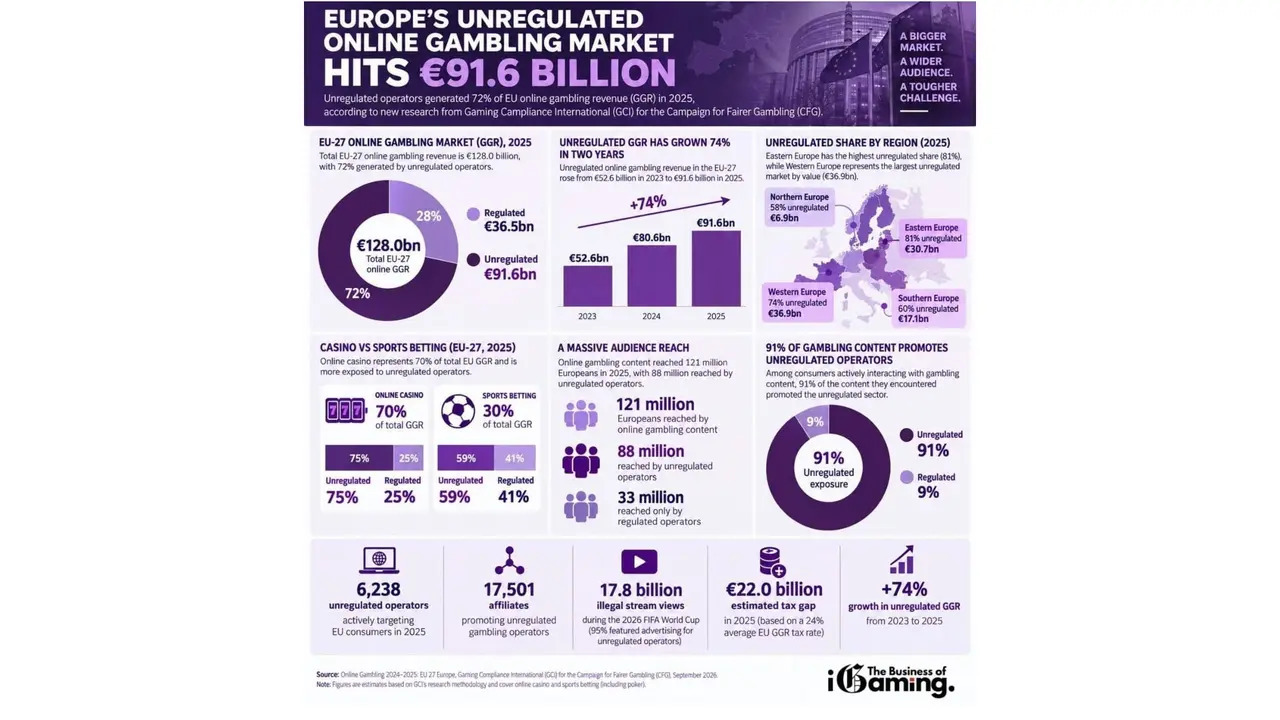
72% of the market is unregulated: Total gross gaming revenue (GGR) from online gambling in the EU stands at €128.0 billion, with a staggering €91.6 billion (72%) generated by unregulated operators. By comparison, the regulated market accounts for just €36.5 billion.
Explosive growth of 74%: Between 2023 and 2025 alone, the EU's unregulated market grew by 74%, from €52.6 billion to €91.6 billion.
A €22 billion tax gap: Lost tax revenue for European treasuries resulting from the grey market is estimated at €22.0 billion a year, based on an average EU tax rate of 24%.
Eastern Europe — the epicentre of the grey market: While Western Europe has the largest market by volume (€36.9 billion), Eastern Europe leads in the share of unregulated gambling, at a record 81% (€30.7 billion). In online casinos, unregulated operators account for 75% of the market, while in sports betting they account for 59% of total turnover.
The illusion of censorship: 91% of gambling content now promotes the black market
The most critical finding of the GCI report is the figure of 91%:
91% of gambling content reaching consumers in the EU promotes the unregulated sector.
Bans on advertising in traditional media do not reduce people's exposure to gambling. Instead, they redirect the traffic:
Massive reach: Online gambling-related content reaches 121 million Europeans, 88 million of whom are directly reached by unregulated operators.
An army of intermediaries: More than 17,501 affiliate partners and over 6,238 unregulated operators actively target EU consumers through social media, influencers, streaming platforms such as Kick, apps and covert marketing, including cloaked ads.
Pirated content takeover: During the 2026 FIFA World Cup, as many as 95% of pirated online broadcasts in Europe displayed advertisements for unlicensed gambling operators, across a total of 17.8 billion views of illegal streams.
The battle is now being fought long before a consumer opens a particular website — it takes place across the entire digital ecosystem. When regulation removes legitimate brands from the picture, shadow operators step in to fill the gap, with no such constraints.
The Italian experiment: seven years of a total ban and a catastrophic failure
If European statistics illustrate the scale of the problem, Italy is an example of how it happens. In 2018, Rome adopted the Decreto Dignità (Law No. 96/2018), introducing a total ban on advertising and sponsorship for all forms of gambling from 1 January 2019.
At the time, the Italian Parliament's Budget Office (Servizio Bilancio, 19 July 2018) issued an explicit warning:
"Advertising and sponsorship are the only way for legal operators to become recognisable to players and distinguish themselves from illegal operators."
Seven years later, data from Italian institutions point to complete failure:
A black market worth almost €30 billion: A study by LUISS University and Prisma estimates Italy's illegal gambling market at €29.8 billion, of which 85% (€25.4 billion) is online.
Minimal impact on protection: Nexus Data Room reports that more than 4.5 million Italians visited unlicensed platforms in the first quarter of 2026 alone, generating more than 13 million sessions. The main point of contact has shifted from television to Facebook, TikTok and Instagram, which have been flooded with aggressive advertising from blacklisted sites.
Blocking does not work: Italy's Customs and Monopolies Agency (ADM) reports a year-on-year increase in blocked sites: 492 in 2023, 721 in 2024 and 1,038 in 2025, with more than 12,000 sites blocked since 2019. ADM itself acknowledges that this merely demonstrates the grey market's shift towards increasingly flexible digital channels.
A blow to sport: The Italian Football Federation (FIGC) described the ban as "largely ineffective" in tackling addiction and illegal betting, while estimating direct losses to professional football at more than €1 billion.
Today, Italy's communications regulator AGCOM and the relevant ministries are looking for a way to address this market imbalance and are preparing legislation to partially restore sports sponsorship and introduce a framework for "responsible commercial communications".
The Bulgarian lesson: Why repeat measures that have already failed?
Against the backdrop of an EU-wide 81% share of unregulated gambling in Eastern Europe and the collapse of the Italian model, attempts in Bulgaria to impose blanket bans appear to risk falling into the same trap:
Destroying brand recognition: When legal operators are not allowed to display their licence, brand and responsible gambling rules, consumers lose their bearings and cannot distinguish a safe site from a dangerous one.
No protection for vulnerable people: Unregulated platforms do not comply with national registers of vulnerable people, do not verify users' age and do not guarantee the payment of winnings.
A financial shock for sport and the media: Cutting the media and sports sectors off from transparent sponsorship deals only strengthens the grey economy, without reducing the presence of gambling messages on social media.
The solution: sustainable regulation instead of populist bans
Leading European economies have long demonstrated that the answer lies not in prohibition but in strict oversight:
Germany: Applies clear time restrictions and content rules under the State Treaty on Gambling (2021).
Spain: Following a revision of Royal Decree 958/2020, regulates specific broadcasting slots.
Ireland: Relies on time restrictions and user opt-in consent for digital marketing under the Gambling Regulation Act 2024.
The Netherlands: Requires targeted advertising with age filters to ensure that young people are not exposed to gambling content.
Demand for gambling does not disappear when advertising on billboards or national media is banned. It simply shifts elsewhere.
With an unregulated EU market worth €91.6 billion and illegal operators accounting for 91% of the online market, the lesson is clear: every extreme restriction imposed on the legitimate sector is a free gift to the black market. Bulgaria should stop repeating other countries' mistakes and focus on strict oversight, digital literacy and preserving a legitimate channel of communication between the state, operators and society.
Source: Novini.bg
Парадоксът на рестрикциите
Как забраните върху хазарта захранват сенчест пазар за 92 милиарда евро в Европа
Когато законодателната дейност се ръководи от популизъм и илюзията за „лесни решения“, крайният резултат почти винаги е противоположен на заявените намерения. Един от най-ярките и тревожни примери за това е секторът на хазартните игри. Под претекст за защита на уязвимите групи и превенция на зависимостите, крайните забрани и зле дефинираните рестрикции постигат само едно: изтласкват милиони потребители право в ръцете на сивия сектор и офшорните оператори, лишавайки държавите от милиарди евро приходи, а обществото – от реална защита.
Европейският шок: 91,6 милиарда евро в сенчестия сектор
Мащабът на проблема отдавна надхвърля рамките на отделни държави и се превръща в системен европейски колапс. Данните от мащабния 48-страничен доклад на Gaming Compliance International (GCI) за Campaign for Fairer Gambling (CFG) (септември 2026 г.) показват шокиращи реалности за европейския пазар (ЕС-27):
72% от пазара е нерегулиран: Общият брутен приход (GGR) от онлайн хазарт в ЕС възлиза на 128,0 млрд. евро, като колосалните 91,6 млрд. евро (72%) се генерират от нерегулирани оператори. За сравнение, легалният пазар държи едва 36,5 млрд. евро.
Експлозивен ръст от +74%: Само между 2023 г. и 2025 г. нерегулираният пазар в ЕС се е увеличил със 74% — от 52,6 млрд. евро до 91,6 млрд. евро.
Данъчна дупка от 22 млрд. евро: Пропуснатите данъчни постъпления за европейските хазни в резултат на сивия сектор се оценяват на 22,0 млрд. евро годишно (при средна данъчна ставка в ЕС от 24%).
Източна Европа – епицентър на сивия пазар: Докато Западна Европа държи най-голям пазарен дял по обем (36,9 млрд. евро), Източна Европа е начело по дял на нерегулирания сектор с рекордните 81% (30,7 млрд. евро). В онлайн казино сектора нерегулираните играчи владеят 75%, а при спортните залози – 59% от целия оборот.
Заблудата на цензурата: 91% от съдържанието вече рекламира черния пазар
Най-критичният извод от доклада на GCI е числото 91%:
91% от хазартното съдържание, до което достигат потребителите в ЕС, промотира именно нерегулирания сектор.
Забраните за реклама в традиционните медии не намаляват излагането на аудиторията на хазарт, а пренасочват трафика:
Мащабен обхват: Съдържанието, свързано с онлайн хазарт, достига до 121 милиона европейци, от които 88 милиона са пряко достигнати от нерегулирани оператори.
Армия от посредници: Над 17 501 афилиейт партньори и над 6 238 нерегулирани оператори активно таргетират потребителите в ЕС чрез социални мрежи, инфлуенсъри, стрийминг платформи (напр. Kick), приложения и скрит маркетинг (cloaked ads).
Превземане на пиратското съдържание: По време на Световното първенство по футбол 2026 г. цели 95% от пиратските онлайн излъчвания в Европа са показвали реклами на нелицензирани хазартни оператори (при общо 17,8 млрд. гледания на нелегални стриймове).
Битката вече се води много преди потребителят да отвори даден уебсайт – тя е в цялата дигитална екосистема. Когато легалните брандове са изтрити от регулациите, сенчестите структури заемат тяхното място без никакви скрупули.
Италианският експеримент: 7 години пълна забрана и катастрофален провал
Ако европейската статистика илюстрира мащаба, то Италия е примерът за това как се стига до него. През 2018 г. Рим прие декрета Decreto Dignità (Закон № 96/2018), с който от 1 януари 2019 г. наложи пълна забрана за реклама и спонсорство на всякакви хазартни игри.
Още тогава Бюджетната служба на италианския парламент (Servizio Bilancio, 19.07.2018 г.) изрично предупреди:
„Рекламата и спонсорството са единственият начин легалните оператори да станат разпознаваеми за играчите и да се разграничат от нелегалните оператори.“
Седем години по-късно данните на италианските институции показват пълен крах:
Черен пазар за близо 30 млрд. евро: Изследване на университета LUISS и Prisma оценява нелегалния хазартен пазар в Италия на 29,8 млрд. евро, като 85% (25,4 млрд. евро) е онлайн.
Минимален ефект върху защитата: Обсерваторията Nexus Data Room отчита, че само за първото тримесечие на 2026 г. над 4,5 млн. италианци са посетили нелицензирани платформи (над 13 млн. сесии). Каналът за контакт се премести от телевизията към Facebook, TikTok и Instagram, залети от агресивни реклами на сайтове от черния списък.
Блокирането не работи: Италианската митническа и монополна агенция (ADM) отчита ежегоден ръст на спрените сайтове: 492 (2023 г.), 721 (2024 г.), 1 038 (2025 г.) и над 12 000 блокирани сайта от 2019 г. насам. ADM сама признава, че това единствено показва преминаването на сивия сектор към все по-гъвкави дигитални канали.
Удар по спорта: Италианската футболна федерация (FIGC) определи забраната като „до голяма степен неефективна“ срещу пристрастяването и нелегалните залози, но довела до над 1 млрд. евро преки загуби за професионалния футбол.
Днес италианският регулатор AGCOM и ресорните министерства търсят изход от пазарната асиметрия и готвят законодателство за частично връщане на спортното спонсорство и въвеждане на режим за „отговорни търговски съобщения“.
Българският урок: Защо повтаряме доказано провалени мерки?
На фона на общоевропейския дял от 81% нерегулиран пазар в Източна Европа и краха на италианския модел, опитите в България за механично налагане на тотални забрани изглеждат като доброволно скачане в същия капан:
Разрушаване на разпознаваемостта: Когато легалният оператор няма право да покаже лиценза, бранда и правилата си за отговорна игра, потребителят губи ориентация и не може да отличи безопасния от опасния сайт.
Нулева защита за уязвимите: Нерегулираните платформи не спазват националните регистри на уязвимите лица, нямат верификация за пълнолетие и не гарантират изплащане на печалби.
Финансов шок за спорта и медиите: Лишаването на медийния и спортния сектор от прозрачни спонсорски договори само засилва сивата икономика, без да намали присъствието на хазартни съобщения в социалните мрежи.
Решението: Устойчива регулация вместо популистки забрани
Водещите европейски икономики отдавна доказаха, че пътят не е забраната, а стриктният контрол:
Германия: Прилага ясни часови пояси и ограничения на съдържанието чрез Държавния договор за хазарта (2021 г.).
Испания: След ревизия на Кралски указ 958/2020 регламентира точни слотове за излъчване.
Ирландия: Залага на часови ограничения и предварително съгласие (opt-in) от потребителите за дигитален маркетинг чрез Gambling Regulation Act 2024.
Нидерландия: Изисква насочена реклама с възрастови филтри, гарантиращи, че младежите не се излагат на хазартно съдържание.
Хазартното търсене не изчезва със забрани върху рекламните пана или националните медии. То просто се пренасочва.
С 91,6 милиарда евро нерегулиран пазар в ЕС и 91% присъствие на нелегални оператори в онлайн пространството, урокът е кристално ясен: всяка крайна рестрикция срещу белия бизнес е безплатен подарък за черния пазар. България трябва да спре да повтаря чужди грешки и да заложи на строг надзор, цифрова грамотност и запазване на легалния канал за комуникация между държава, оператори и общество.
Източник на материала: Novini.bg
-
COMMENTING RULES
Commenting on www.vagabond.bg
Vagabond Media Ltd requires you to submit a valid email to comment on www.vagabond.bg to secure that you are not a bot or a spammer. Learn more on how the company manages your personal information on our Privacy Policy. By filling the comment form you declare that you will not use www.vagabond.bg for the purpose of violating the laws of the Republic of Bulgaria. When commenting on www.vagabond.bg please observe some simple rules. You must avoid sexually explicit language and racist, vulgar, religiously intolerant or obscene comments aiming to insult Vagabond Media Ltd, other companies, countries, nationalities, confessions or authors of postings and/or other comments. Do not post spam. Write in English. Unsolicited commercial messages, obscene postings and personal attacks will be removed without notice. The comments will be moderated and may take some time to appear on www.vagabond.bg.



Add new comment